 After my eyes adjusted to the deluge of perfect pecs and smooth bodies gyrating in athletic finesse, I saw past the blinding stage lights, past the penis pump, past the sleaze-ball that is Matthew McConaughey — and was left with a sorry representation of the male stripper industry.
I suppose it was my inherent curiosity for all things “stripper” that led me to the ticket booth to spend almost ten dollars on a movie whose only selling point was a trailer showing bodacious dance moves by artisanally sculpted bodies. After finishing the first stage of my documentary on high-end strip clubs in Pittsburgh, I became very interested in how Hollywood portrays the industry for both females and males. So when this unbelievably enticing trailer hit previews, I leapt at the chance to expand my knowledge.
My independent project, “It’s All Play,” began the moment I realized I had so many scathing opinions and assumptions about female exotic dancers but had never stepped foot inside a strip club – let alone ever have a conversation with a dancer. I embarked on a journey to see how female dancers view themselves, and how their work makes them feel at the end of the day (one described her job as being a “dressed-up, sexier counselor”). I wanted people to recognize their own assumptions of the industry by hearing from the dancers themselves. (Side note: For those of you interested in finding out more about this project, a website is in the works, and the final, full-length documentary is expected to be finished in the summer of 2013).
I expected Magic Mike would take a similar approach to my own investigation by examining how male dancers respond to being objectified. I expected humility and grace, maybe with a dose of resentment. Instead, I was delivered a steaming pile of chauvinism with only an afterthought of introspection worthy of empathy.
Within the first two minutes of the film, we’re introduced to Mike Martingano’s (Channing Tatum) naked butt, and then immediately to a topless Joanna (Olivia Munn), Mike’s recurring booty call. Then the camera panned down towards the third party in the room, a sleeping naked woman, one whose name neither Mike nor Joanna could remember. Mike dismisses their blunder with the flippant remark, “Well, she was a good time, anyway.”
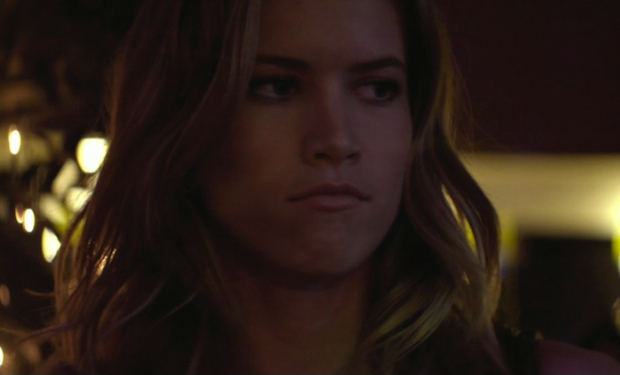
The movie continues in this vein. Shortly after leaving his heavenly ménage-a-trois, Mike meets Adam, our secondary hero who is eventually deemed “The Kid,” played by chiseled-face Alex Pettyfer. Adam is responsible for introducing Mike to his sister, Brooke (Cody Horn), the woman Mike chases–quite pathetically if I may add–for the entire movie.
Adam is the lost little boy who allows drugs and destructive women to persuade him away from Mike’s big-brotherly wing, while Brooke is the only “strong” female character (out of two featured actresses), where “strong” translates into angry pouts and nagging comments that went against what every other drooling woman thought of Mike. Even her convictions were shallow, for in the end her determined refusal of Magic Mike’s flirty charms is eventually won over …by (*SPOILER*) his flirty charms.
For all intents and purposes, this movie was made for the stereotypical male mind but for the stereotypical female’s eyes. It reserves itself from fully expressing emotion, yet tries to pass itself off as compassionate to the empathetic women. As if all we needed to sway us to see their point of view is a few bare derrières and sappy pick-up lines!
Well, apparently it’s enough for some people. NY Times’ film critic, Manohla Dargus, couldn’t praise the movie enough. In the similar fashion as I began this post, she blushes,
She continues by highlighting the movie’s swapped gender roles:
She does have a point. How many movies can you think of where the male gaze is directed at the men? You know, scenes that have the slow, panning-up of a semi-naked man coming out of the water, or thoughtfully turning his face towards the sky so it glows like Zeus in the sunlight? For straight women and gay men, Magic Mike is a voyeuristic feast fit for royalty. But it can’t shake the irresistible urge to cater to straight men’s fantasies.
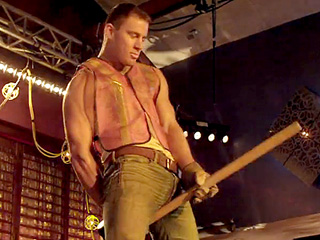 In almost every dance number, a woman from the audience is whisked out of her chair and is literally tossed around to eventually land in a sexually compromising position underneath (or splayed across) the dancer. The argument for “The Kid” to start dancing was that he could be “the husband they never had! You are that dreamboat guy that never came along!” Magic Mike is as every bit of a guidebook to the “masculine” as he is an ideal sexual partner.
But perhaps I am turning mole hills into mountains and making an actually progressive movie to sound tirelessly sexist. If I am projecting my own presuppositions on a story that is clearly novel in what it represents, tell me! These are difficult concepts for anyone to wrap their minds around, and conversation is a must if we are to get to the bottom of these concepts.
I’m sure if we had Channing Tatum and Steven Soderbergh on the phone we could gain more insight. But until I make best friends with them to invite them to talk stripping and sexuality (don’t worry, it’s a work in progress), we’ll have to resign to the comment section below.

