Tuesday, August 7, 2012

Magic Mike, Same Old Tricks

[Original post was written on August 2nd for Powered By Girl and can be seen on SPARK a Movement's website.]


After my eyes adjusted to the deluge of perfect pecs and smooth bodies gyrating in athletic finesse, I saw past the blinding stage lights, past the penis pump, past the sleaze-ball that is Matthew McConaughey — and was left with a sorry representation of the male stripper industry.
I suppose it was my inherent curiosity for all things “stripper” that led me to the ticket booth to spend almost ten dollars on a movie whose only selling point was a trailer showing bodacious dance moves by artisanally sculpted bodies. After finishing the first stage of my documentary on high-end strip clubs in Pittsburgh, I became very interested in how Hollywood portrays the industry for both females and males. So when this unbelievably enticing trailer hit previews, I leapt at the chance to expand my knowledge.
My independent project, “It’s All Play,” began the moment I realized I had so many scathing opinions and assumptions about female exotic dancers but had never stepped foot inside a strip club – let alone ever have a conversation with a dancer. I embarked on a journey to see how female dancers view themselves, and how their work makes them feel at the end of the day (one described her job as being a “dressed-up, sexier counselor”).  I wanted people to recognize their own assumptions of the industry by hearing from the dancers themselves. (Side note: For those of you interested in finding out more about this project, a website is in the works, and the final, full-length documentary is expected to be finished in the summer of 2013).
I expected Magic Mike would take a similar approach to my own investigation by examining how male dancers respond to being objectified.  I expected humility and grace, maybe with a dose of resentment. Instead, I was delivered a steaming pile of chauvinism with only an afterthought of introspection worthy of empathy.
Within the first two minutes of the film, we’re introduced to Mike Martingano’s (Channing Tatum) naked butt, and then immediately to a topless Joanna (Olivia Munn), Mike’s recurring booty call. Then the camera panned down towards the third party in the room, a sleeping naked woman, one whose name neither Mike nor Joanna could remember. Mike dismisses their blunder with the flippant remark, “Well, she was a good time, anyway.”
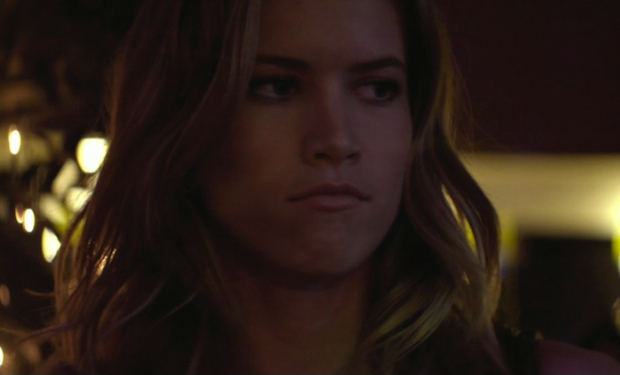
The movie continues in this vein. Shortly after leaving his heavenly ménage-a-trois, Mike meets Adam, our secondary hero who is eventually deemed “The Kid,” played by chiseled-face Alex Pettyfer. Adam is responsible for introducing Mike to his sister, Brooke (Cody Horn), the woman Mike chases–quite pathetically if I may add–for the entire movie.
Adam is the lost little boy who allows drugs and destructive women to persuade him away from Mike’s big-brotherly wing, while Brooke is the only “strong” female character (out of two featured actresses), where “strong” translates into angry pouts and nagging comments that went against what every other drooling woman thought of Mike.  Even her convictions were shallow, for in the end her determined refusal of Magic Mike’s flirty charms is eventually won over …by (*SPOILER*) his flirty charms.
For all intents and purposes, this movie was made for the stereotypical male mind but for the stereotypical female’s eyes. It reserves itself from fully expressing emotion, yet tries to pass itself off as compassionate to the empathetic women. As if all we needed to sway us to see their point of view is a few bare derrières and sappy pick-up lines!
Well, apparently it’s enough for some people. NY Times’ film critic, Manohla Dargus, couldn’t praise the movie enough.  In the similar fashion as I began this post, she blushes,
“Those cheeks, smooth as a hairless Chihuahua, will receive considerable attention, as will the rippling muscles, thrusting pelvises and the dancing, by turns snaky and acrobatic that are on generous display in ‘Magic Mike.’”
She continues by highlighting the movie’s swapped gender roles:
“In one school of thought Hollywood movies are always organized for the visual pleasure of the male spectator, which pretty much leaves the female spectator sidelined. There’s no leaving her out any longer — or the gay or confident heterosexual male spectator, either…. it’s clear the director is out to maximize everyone’s pleasure.”
She does have a point. How many movies can you think of where the male gaze is directed at the men? You know, scenes that have the slow, panning-up of a semi-naked man coming out of the water, or thoughtfully turning his face towards the sky so it glows like Zeus in the sunlight? For straight women and gay men, Magic Mike is a voyeuristic feast fit for royalty. But it can’t shake the irresistible urge to cater to straight men’s fantasies.
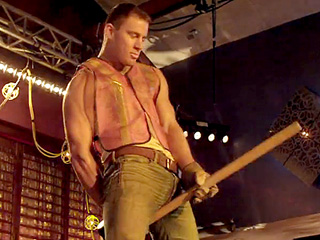
In almost every dance number, a woman from the audience is whisked out of her chair and is literally tossed around to eventually land in a sexually compromising position underneath (or splayed across) the dancer. The argument for “The Kid” to start dancing was that he could be “the husband they never had! You are that dreamboat guy that never came along!” Magic Mike is as every bit of a guidebook to the “masculine” as he is an ideal sexual partner.
But perhaps I am turning mole hills into mountains and making an actually progressive movie to sound tirelessly sexist. If I am projecting my own presuppositions on a story that is clearly novel in what it represents, tell me! These are difficult concepts for anyone to wrap their minds around, and conversation is a must if we are to get to the bottom of these concepts.
I’m sure if we had Channing Tatum and Steven Soderbergh on the phone we could gain more insight. But until I make best friends with them to invite them to talk stripping and sexuality (don’t worry, it’s a work in progress), we’ll have to resign to the comment section below.

Sunday, July 1, 2012

First Month's Reflection

Today marks the one-month anniversary of kissing Pittsburgh goodbye and making the physical transition down to Hendersonville, NC to begin a year-long stint as an Americorps VISTA service worker. The settling in was seamless, thanks to the many generous donations provided by my organization's staff, board members, and friends. And the stereotyped social graciousness of people in the South cannot be understated - people truly have welcomed us into their homes and hearts as though we were old friends. The decision to migrate out of the city I've affectionately deemed my sibling (you grow up together, you don't always get along, but you know you will never stop loving each other) was an easy one in the midst of a fitful Spring, fighting to preserve a sense of "normalcy" when life was clearly trying to carry me down a completely different path. I still wonder if I wasn't acting on a fight-or-flight impulse, but regardless of the deep-seeded reasons, I'm here, and I'm happy. 

...But just not as present as I should be. One eye is focused on my new job and feeding new relationships, but the other is still fixated on the treasures I left in da 'Burgh. Of course, this is natural. It's one month in North Carolina versus 19 years living up north. However I'm not satisfied with this. After all, the goal was to uproot myself from my comfort zone so I could really begin to see. But at the end of the day, my concerns and thoughts are still with those who are no longer physically around me. I'm terrified of losing connections to who I am, who I came from, of being forgotten. Do I have to alienate myself from one place to feel genuinely connected to the other? What does that balance look like?

Dissecting Earth and sky
"...somewhere between
the earth and the sky."
It should be stated that I do not sit at home pining to be included in the lives of those I miss back home.  Ooooh no no no. I do stuff! Just yesterday I swam in the Broad River, watching turtles peak their heads out of the water and older vacationers reliving their hey-days at a tiki bar's karaoke night. I visit Asheville whenever I can to satiate my addiction for a bustling downtown environment. I started attending services at the local Unitarian Universalist congregation. I mean, I'm even learning how to play the fiddle! (Expect to be impressed in the months to come :-).)  I have all the nature and breweries I could wish for within a half hour of where I live, in every direction; there is little reason for me to reject this new environment.  In fact, part of me believes that most of my anxieties come from the fear that I might not ever want to return for good. But who could possibly make that decision at this juncture? Anyway, I digress...

In this month's issue of Yoga Journal Lisa Walford's article set out to explain the dynamic pose of Anantasana, and instead identified the need for us to lose our balance for our own healthful gain: (I took editorial ownership and removed any pose-specific words.)
"...finding your balance is a constant, dynamic process. It's a dance that changes from moment to moment. By staying sensitive, clear, and courageous, you can become more aware of the tiny adjustments that you need to make in order to stay stable. Losing your balance is not a bad thing; it brings the edges of extremes to light and shows you where you need more physical or mental support."
Rereading this passage, I replaced the word "balance" with "way," and felt more at peace with easing my white-knuckled stronghold on Pittsburgh.  I view loved ones from home to be static representations of where I come from. And if ever I lose my footing, I just reach for those connections to bring me back on track. It's an exciting prospect, if not a vulnerable one, for sure.  Losing ground will be the best thing to happen to me. I just need to first accept the invitation to fall.

Wednesday, June 27, 2012

KEEP IT REAL


No one told me I was smart when I was a child; they only said I was pretty.  At 10, I never read books with strong female leads like Junie B. Jones or Stargirl; I was too busy learning the best ab work-outs and how to apply mascara from the articles in Seventeen. I’m turning 23 in one week and to this day, I wake up every morning to see how my belly juts out against my pants. I still feel like a failure every time my cravings concede to a piece of chocolate. But I know the beast that made me. I dedicated my academic career to studying gender behavior and media theory to help destroy it. And I will continue to do everything in my power not to let this mental condition get the best of another girl.  Because we are more than our waist line, our bust size, our skin tone, or our curves. Our aspirations are greater than wanting to be thin, wanting a boyfriend, or coveting to have all the attention in the school. Deep within every girl is gumption and drive, yet at such formative ages those amazing qualities are too easily snuffed out of existence by glitzy media saying “Who you think you are isn’t who you should be.”

Recently I worked as a site leader for a youth group coming in to help fix up a home for someone in need. The ice-breaker question I posed was “What did you want to be when you were a child?” There were 9 people in the group, 6 of them girls. One girl named Jeannie said, “Astronaut.” One girl named Katie said, “cake decorator.” And another girl, Lauren, said, “Concert pianist.”  Later in the day, I asked some of the girls what their life aspirations were. Katie said, “To get a boyfriend.” Jeannie said, “To be a supermodel.” When I prodded them some more, it was revealed that Katie wants to travel to Italy and that secretly she still wanted to open her own cake-decorating business.

It compels me to tears thinking about how much energy and attention I devoted to complying to the rules laid out for me in those early issues of Cosmo Girl and Seventeen. And to see girls openly changing their goals to match the roles they see their idols filling in magazines and TV shows shallows my breath. If ad agencies and magazine editors and TV scriptwriters do not start realizing the immense impact they have on young minds, and how damaging it is to them and in return, our nation, our society, our world will never change. It’s time to keep it real, people. 

Tuesday, June 12, 2012

What a Man, What a Man, What a Mighty Confused Man.

The pattern couldn't have been more obvious if it were featured on Good Morning America as a breaking trend.  A few days ago BBC listed two reports back-to-back on their US & Canada headline stream (coincidentally?) that featured a common theme among adult males in combat and on the football field:

Suicide.

The manliest men on the Masculine Persona spectrum (not a real spectrum, don't look it up.) are choosing more and more to take their lives. Or are we just finally paying attention to it now? And if so, what happened to make our consciousness more aware of the trend?
The first of these headlines needed no further description to understand the severity of the issue: "US military suicide rates hits one per day". BBC cited an increase of 20% in the number of deaths reported were reported this time last year.  The Pentagon referred to the issue as "one of the most urgent problems" they faced.  PTSD is ubiquitous among veterans returning home from combat, but these cases of suicide are cropping up among members currently deployed or are about to be deployed.  And rather than receiving unanimous support, stories of men taking their lives receive chastising remarks from their higher-ups.
The subsequent article begged the viewer to read on beyond the headline. Titled, "NFL players join forces to sue league over concussion," the article detailed components in the lawsuit as saying the NFL has "glorified violence" via media marketing ploys.  At the end of the article, Mary Ann Easterling , the wife of late Atlanta Falcolns' safety, Ray Easterling, cites the tragedy of her husband's suicide as a result of his deep-seeded behavioral problems due to persistent head trauma.

So what exactly are we seeing here? Well, think of all the stereotypes you might use to describe a typical GI Joe or first-draft linebacker: muscular, dumb jock, heroic, hard-headed, proud, master of their jurisdiction, capable of fixing anything.  Any association that implies a correlation to physical aptitude and worth to society, basically.  Notice how any adjective describing vulnerability is completely absent.  Just as stereotypes assume women to be weak, defensive cry-babies, the "masculine" man is expected to be exactly the opposite.

But the times, they have been a-changing - we are shattering these definitions left and right, on both sides of the gender divide.  We are seeing a spike in the number of women who volunteer for combat, raising consciousness over the unhealthy practice of Photoshopping, and sloooowly but surely voting more women into public office. And studies repeatedly show how boys are being left in the lurch next girls' progress in the American education system. This is a huge testament to immeasurable work women throughout the century completed to achieve gender equality in schools. However... while one side is working full-time to level the playing field, the other is left eating their dust.  

It took years and a fantastic professor to open my eyes on the problem that young men in America are facing today.  Men are not getting the appropriate attention needed to facilitate a seamless transition away from rigid, archaic stereotypes, let alone enough support to back them up in the roles they are responsible for upholding now.  The need for a transition from "macho" to "human" is one that is absolutely vital in achieving gender equity in every facet of society. Yet at every turn, organizations and major establishments such as the NFL and Hollywood (I could write a whole separate seething film review of the movie, What to Expect When Expecting, don't get me started.) take the most lucrative road and buy into furthering these disastrous stereotypes while trying to promote the gender they're glorifying.  The more pressure men receive to sustain the one-dimensional role of being physically-impressive, the more there will be pressure building up against their repressed emotions of living in a world that is paying more attention to women. 

This is not to say that there is still not an immense burden placed on the Western Woman to adhere to strict physical and emotional confines. Nor is my specific aim to blur the roles between men and women.  For the vast majority of people in this country, guidelines, on some level, are necessary in sustaining sanity.  However, in order for women to break free from dangerous structures surrounding how they act professionally, sexually, emotionally, etc, men need to be shown guidance as they navigate their reassessed roles (i.e. one who is not an abuser, emotionally vacant, or solely focused on physical prowess) in a redirected society.

BUT. There is hope. It has just been announced that the Veterans Affairs council has taken note of the demographic with the lowest rates of suicide to aid them in their attempt to quell the number of suicide attempts in the military:  "[They] hope to re-create elements of black female culture that may help stop military veterans from killing themselves."

The jury is still in discussing the sociological implications of this idea.


Monday, May 2, 2011

Thai Government needs a Makeover

At this point, less than two months before elections, there is still no guarantee that the outcome will not result in massive-scale of protests, violent or otherwise - this cycle of political instability stirring unrest after close-call elections will repeat itself over and over again, unless Thailand recognizes the missing element needed to form an actual democracy: women.

In Thailand's upcoming elections culminating in June (we hope), the contending parties are once again cookie-cutter contenders of their power-hungry, money-squandering predecessors.  The Thai-Cambodian border dispute distanced royalist-supporters, PAD, from the Prime Minister Abhisit due to his lack of decisive tactics to end the conflict.  Since the shift in loyality, a division of PAD attached itself with smaller coalitions that polls estimate will increase the Democrat party chances of winning over their opposition, Phuah Thai Party, in the southern and central Thai provinces.  However, a separate sect of PAD is petitioning to boycott the elections altogether due to the Red Shirts calling for national reconciliation.

The Red Shirt's Phuah Thai Party, on the other hand, is receiving emotional and monetary support from former billionaire PM, Thaksin Shinawatra, who vocalized that if PTP wins, he will come back from exile to fulfill his grandiose pro-poor policies.  Inevitably, if carried out, this promise would end in disastrous rebellion from the anti-Thaksin half of the nation.

Despite Thailand being one of the first countries to grant women the right to vote, their learning curve has been dramatically slow since.  The collective voice of women in parliament is nothing if not ambient noise next to the corrupt cacophony of that of their male counterparts.  Women average around 5 percent of the members in each committee of Parliament; they make up 15 percent of Parliament as a whole, and the same percentage in the senate.  Women's groups in Thailand have tried their hand at pipelining women directly into central administration, but the flow stops at gender-sensitive committees, such as tourism agencies or ministries overseeing children and parental development, that keep women in peripheral spheres of power.  When their influence is confined to mere subsets of government, then the process to define policy has unequal representation from members of society, and therefore cannot be considered a true democracy.

Yet, paradoxically, women hold more responsibility in the village sphere. Nong Wang is a slum community in Khon Kaen Province who recently received the deed to a new legal plot of land after years of dedicated protest.  The community's voice, their cheerleader, and organizer is Meh Joi.  A mother of two and grandmother of 2, and a leader of 86 families. Her role in leading the community was directly related to the success the village had in getting the lease to their land.  


In another part of the region, a Learning Center is developing to educate younger generations living in Rasi Salia and Hua Na villages about their culture's way of life post-Rasi Salai dam.  Leading this coalition to build an all-inclusive educational environment is Meh Paw, the communities' force to hold them all accountable.


And we can't forget about Wanita Sarawak, the bold woman who fronted the movement that led the Assembly of the Poor from their Northeast corner to Bangkok's front door to demand rights.


So what does this mean that capable, headstrong, value-oriented individuals like these women aren't seen more in office?

Probably because they are capable, headstrong, and value-oriented. 

Democracy in Thailand is a system based around who has the most money and influence over the rest of Parliament.  Even if Thai women had more of an interest to break into legislation, there would be no support to validate their honest values that are for the people.  If Thailand is ever going to tear itself away from the cycle of civic unrest, violent uprising, and corrupt government, then maybe it's time for the people leading the movements to start leading their country instead.  


Saturday, April 30, 2011

Counteracting Globalization and Development with Globalization and Development

The following was my entry to our program's blog, Human Perspective on Development and Environment.  Each of us students had to write our reflections about our past unit and what it meant in the greater picture.  Bogged down with two essays and two huge final Thai class projects, my mind has been in condition to analyze heavily as to what our actions mean in terms of development and globalization in Thailand.  So forgive me if the writing and train of thought are muddled, verbose pieces of organic cow manure. Can't win 'em every time. :)

A professor once said, "Knowledge is meaningless if you don't affect multiple levels."  What I've learned during these intense last three months is that the scope of knowledge itself is relevant.  An organic farmer will value how to make her/his own compost fertilizer over knowing how the chemical components in fertilizer help break down the soil; on the other hand, an NGO covets the skill to conduct research so that they can provide as much information to a community as possible.  What is important to know shifts relative to where a person is and what that person is doing.   Most importantly, knowledge, as a general rule, should not only serve the area where it was gained, but must transcend to higher and deeper levels to be more effectively sustained.

Like "knowledge," the words "development" and "globalization" also have very different meanings depending on a person's perspective and location.  For a company like the Puthep Mining Company, development plays into globalization when erecting a copper mine in order to give Thailand more clout as a global player in the international market.  To a community of fishermen working to preserve their wetlands after being flooded by a dam, development and globalization might look like increasing members in their movement by extending to other communities in the world dealing with the same issue.   
If knowledge is dependent on where you are, and knowledge is meaningless unless shared, then different places' knowledge-base must be shared with other people in other places.  To some, this sharing of knowledge is one method of development.  To others, this is also globalization at work:  It is spreading skills and resources to increase knowledge in other plans. But the paradox comes when the resources being shared are destroying the integrity of a place, then the resource is irrelevant to have.  As soon as infrastructure as development impedes on intellect as development, then something's gotta give. 
Just as knowledge must be shared and interpreted through different lenses in order to practically implement it, there needs to be interaction between multiple players on the global scale when discussing ideas of development.  Large-scale development schemes that have the potential of impacting hoards of people need to first reach an understanding with the people it would be affecting to weigh the pros and cons of erecting the project.  Ideally, this is what an EIA is meant to fulfill (whether or not this process is righteously carried out or not is another story). 
The daunting "project time" has begun.  Our DG group is splitting up to spread our collective knowledge on globalization, development, and human rights out among the Isaan region.  Despite our separate focuses and goals with each project, each of us are playing the role of educator in one form or another.  We are all acting in part as researchers, compiling information to enhance the fight of the effected community with which each of us will be working, based on the need of each community.  Our development is spreading our knowledge throughout multiple communities so that they may develop their organizations to become more efficient and more powerful. 

~J.

Saturday, April 23, 2011

A Survivor's Path to Leading a Movement

Mukhtar Mai, a strong women's rights advocate after
having been gang-raped back in 2002, fears for her safety after
5 of her 6 attackers were released after the Pakistani Supreme Court
upheld their 2005 decision to acquit the suspects.
(Photo source: BBC)

On Thursday, the Pakistani court upheld their 2005 statement to acquit all but one of Mukhtar Mai's 6 suspected attackers.  

Mukhtar Mai became an international superstar for human rights sympathizers after she publicized in 2002 what had happened to her in the name of "honor."  Allegedly, she was gang-raped by six men as a punishment for her younger brother's illicit fraternization with an older women of a rival tribe (later it was investigated that this allegation was a cover-up to his being molested by members from said tribe).  Adding insult to injury, to come out as a single woman saying  she was raped was an invitation to even greater danger:  Before President Pervez Musharraf changed the laws surrounding rape in 2005 (as a reaction to the uproar received from the international political and activist communities), Pakistani criminal court characterized premarital sex an act punishable by death. 

Since the initial movement to acquit the offenders in 2005, Mai has had to be weary of backlash from people in her own country who support traditional Muslim law, a law which translates today as supporting perpetrators and punishing rape survivors.  Immediately upon announcing her story to the world, her virtuous pursuit for justice was glorified in every corner of the free world, from Nikolas Kristoff's reporting on her all-girls' schools erected throughout Pakistan to educate young females about their rights as humans in Half the Sky, to Glamor magazine declaring her Woman of the Year in 2006.  Now, though, with the final ruling, her old fears have resurfaced.  (Read about the case's events here.)

President Musharraf took a lot of heat after he made a comment implying that rape was a money-ticket for Pakistani women to settle into a better life abroad (Aljazeera).  While a little progress is better than no progress in the context of Pakistan's dated gender laws, and that Musharraf's "change of heart" had much to do with the United States' firm demands, there is a lot to be said that despite Mai's celebrity status internationally, and widespread support from human rights activists and social developers alike, Lady Justice favored her attackers.  Here is an example of how progressive policy changes are ineffectual when not backed by the culture over which it sees.  Muslim supporters protested against President Musharraf's decision to amend Pakistan's rape laws.  No matter how much ballyhoo the international community makes, the world's second-largest Muslim-inhabited country ultimately has to be its own driving force.  It has to want to make a change in how it perceives and treats women. Which is why Mukhtar Mai's decision to open two schools in her region is the course of social action outsiders should be supporting the most.  

Culture encompasses and fuses a community's past and present, and its rate of change is as fast as the movements within it are growing.  Children learn about the culture in which they live, simultaneous to learning where they fit in relation to the rest of the world.  If social change must happen on a grand scale, i.e. across entire religiously-founded regions, then broadening the world view of youth on a local level is crucial to spark that movement.  The ideal and, perhaps, only way to enact sustainable change is to experiment with  models of alternative education that are grounded on one core issue, be it a civil or developmental one, and converge all other disciplines around that core while engaging students with the community they live in.  Culture is invaluable to this process as well.  When the community takes agency in what their youth or young women are learning, the discourse surrounding social action starts to become enmeshed with the status quo.  This is exactly what Mukhtar has succeeded in developing thus far. 

Although Mukhtar Mai's cases is an important milestone in marking Pakistan's civil development and should be read by anyone engaged in international women's rights, let it not go ignored the same kinds of barricades to equality seen in America today.  In truth, we are not as righteous as we let ourselves on in terms of granting fair and just treatment to rape survivors.  (A very similar story to Mukhtar Mai's was seen at Washington State just three years ago; the story is definitely worth a look.)  

So from here, where do we go?  Not far.  
For starters, check out Mukhtar Mai's Women's Organization to see the amazing accomplishments her horrific experience has bred in her community.  Ways to donate are also cleverly accessible, and their requests are modest.  From there, examine what you value most in a functioning, equitable society, and explore ways you can integrate progressive movements into your already established culture.  An example might be signing up for (or creating, even!) theater classes centered around a hot social issue happening in your community (New Orleans has one - check it out!)  
Or, in light of tomorrow's holiday, it could look like attending Easter service at a local church with a congregation of widely diverse backgrounds than your own.  There are many ways to help sustain social change that extend far beyond donating money to your most cherished organization.  Take a hint from Mukhtar: start living like you truly believe change can happen, and before you know it, everyone around you will start believing it too.

*jamestress*

Thursday, April 7, 2011

Laying the Foundation with Tepid Tools

I feel a little ill when I think about how long it has been since I wrote last.  But to all those who think I cut ties, my mind has been busy trying to cope with, well, itself.  And only recently did I finally feel compelled to sit down and share.  It came to my attention sometime a couple weeks ago that there was confusion by some folks back home concerning my reasons for being in Thailand.  And then it came to my attention sometime a couple days ago that I may be just as confused about this, myself.

On my YouTube video on the political struggles seen in Bangkok last year, my ever-insightful uncle commented that this topic had nothing to do with trafficked women's rights.   He had every reason to show concern, too, since he was one of the many generous individuals to contribute to the cost of my trip over here, under the pretense that I would be studying the trends of prostitution.  And not just him: my friends, my family, the family of my friends, my professors...myself.  But not one thing I have posted since arriving has been on the topic of sex trafficking; rather, everything is on agricultural trends, land rights, water management, mining, and their encompassing themes of globalization, development, and human rights.  However, to his comment, I saved face by saying that I was merely laying the foundation for my senior thesis by understanding first the major themes of human rights and globalization in a Thai context before physically researching the topic of human rights and Thai women's agency.  Honestly, that really was what I believed I was doing.

It wasn't until the night before we left for our 5-night-long Unit 4 trip (April 2 - 7) that I realized that I no longer had a grasp on what my future plans were, or what the importance of a formal education in Digital Media had in my life anymroe. Nor did I see the merit of leading individuals through group process so that they could eventually make a positive impact on the world.  For weeks there was an unsettled feeling deeply set in me, but it took a verbal vomit on my friend to identify where, exactly, these feelings were stemming from.  What began with utter resentment of the fact that I will most likely be in school for another hair-graying year and a half turned quickly into questioning the legitimacy of nearly all my goals.  Before I knew it, I was stressing how naive I was to come to Thailand, thinking I could seek to ignite change in a FOREIGN country, with a language and culture I wouldn't dare come close to understanding in a mere four months, when there are ample chances to make realistic change in my backyard - literally.

In the course of these last (not quite) three months my dream of wanting to be a Social Worker/documentary-filmmaker working to better the conditions of sex workers, transformed into wanting to get into journalism, to flirting with the idea of being a policymaker, to seriously considering the steps to becoming a Human Rights lawyer (an idea I'm still tweaking).  But recently, my spirits seemed to have reached their maximum capacity for learning about institutionalized corruption against the marginalized and "impoverished." I found myself asking helpless questions like, "Why should and how do I sincerely care about the progression of someone else's movement when the issue has no direct impact on my life?" and "What can I do as an individual to initiate change at the bottom level when it is macro-level policies which direct the course of status quo?"  This isn't to say I'm already desensitized at such a ripe age of 21, or that I'm so burnt out I can't continue any of my altruistic goals.  These questions are predominantly founded on completely selfish terms.  The seed which planted these aforementioned toxic thoughts is, Can and when will I have time to get mine?

Someone once said, "You can't understand the world until you understand yourself."  I feel I understand Thailand's interconnected economical and environmental movements more than the complexities of my own country's waves of social change.  And I could probably write a novel at this point describing the depth of the 20 characters I've grown to understand since the end of January when this program started.  But it feels like I am further away from knowing myself, and therefore further estranged from this world, than when I started this journey.

I feel I should take this time to brief those who had a part to play in helping me get to Thailand: In no way am I ungrateful or unsatisfied with my decision to study here. This experience is bar non the most necessary venture I've ever had, and there is no doubt in my mind that the experiences I will take from this semester will forever shift the course of my life hereon after. If it weren't for this program, these life-enriching, life-altering mental conversations would never have taken flight.  Or at least, they may have come up in the far future when it is too late. There's a saying that your ultimate goal in life should be to find the place where the world's greatest need and your greatest passion intersect.  I know my passions.  I am just still finding where in the world there is need for them.

~J.

Tuesday, March 1, 2011

Reflections

     A few days ago we returned from a 5-day homestay in the village of Yassothahn, getting a chance to meet organic farmers- some who under contract by a sugarcane factory, and some acknowledging the last generation of farmers on their land -and hearing their stories as they pertain to the issue of sustainable agriculture in a globalized market.  We had the chance to meet with the aforementioned sugarcane factory, and, alongside the farmers who grew the crop, we observed the model of manipulation from the top down, the government-subsidized factory taking a considerable profit from the hard work of hundreds of Isaan farmers. But aside from these intense experiences had with the group, there were moments unique to my interactions with the land and the beautiful people who worked on it that I feel compelled to record.  

Three particular moments I want to share:
1.) The family I stayed with for four days had their lives rich with the freshness of babies: the family just witnessed their youngest daughter give birth to a boy 10 days before me and my friend, Lindsay arrived; one of their cows birthed a calf two days before our arrival; and while we were sleeping one night, their pig gave birth to 10 beautiful piglets.  So much new life all at once! Why does is it still so extraordinary to me? Our "meh" was a grandma - her mother, who was a 69-year-old lady who still helped out on the farm, was now a great-grandma.  And the cycle continues. 
Out of the litter of pigliets, only one had a definitive white spot on its body, and this precious thing also happened to be (coincidentally?) the runt that was left out by its brothers and sisters.  It was the only baby who couldn't get a hold of any of its mother's nipples.  Ahh! I died I died I died, it was too much to handle. Finally "paw" let me hold it. It took all of me to put it back in its pen. I hope it grows up to be president someday.
Mama ('n') Babe
2.)  Lindsay and I walked in on paw and a fellow rice farmer on the floor of the house, fully engaged with signing papers, calculating ledgers, with a bottle of whiskey and two glasses in between them.  We sat nearby watching in silence, trying to pick up any familiar Thai words that we might have learned in class previously.  After a few minutes, and most likely feeling awkward with us staring blankly at them, they offered us each a glass of soda and whiskey.  It wasn't that we got to drink with our Thai father and his comrade that made this moment a memorable one (though that was definitely a highlight of the homestay). It was seeing their business model in action, rather than speculating what it might be like to actually sustain oneself through managing a farm.  The scene also gave Thai farmers more context in my eyes - they were no longer individuals selling their produce at competitive local markets, but helping one another in the broader scheme to have financial capital to show for their hard work.

3.) I interviewed our family's youngest daughter (the 23-year-old, unwed mother of the two-week-old baby) and her father (my "paw") for a feature I am writing, concerning the trend of the younger generation moving out of the farm to start another life in the cities, and how the effects of this migration is compromising the future of the family farm.  What I learned from the daughter's account is that she plans on teaching science in one of the adjacent provinces, and, saying in a lowered voice since she was in earshot of her mother, that if her parents were okay with it, she would leave baby "Chine" with her parents to raise.  Her older sister is also a teacher in a nearby province, though she still lives with her parents to save money for med school.  However, as soon as she saves up, she will also move out of the parents' house as well.  When asked what his plans were for the farm after his two daughters move out, he responded, "Maybe this will be the last generation for the farm." 
"Paw" on his organic rice field.  The buffalo graze on the old land
and their poop fertilizes the soil. Oh, and the week-old baby calf.
All things mentioned are pretty incredible. 
   Organic farming is how roughly 5000 farmers grow their crops, and to them, it is more than a healthy decision.  Their produce being organic is mainly a byproduct of an integrated system of agriculture, one that requires a kind of devotion that defines someone's identity, a devotion that this sort of agriculture depends on to sustain itself.  But now with this new recent education migration, values are shifting away from upholding traditional communal farming techniques towards a more individualistic motivation.  And during a time when corporations are buying out farmers' lands to monocrop for a profit, small-scale, family-run organic farms are losing all fighting chance they have left.  

  A few times, our group discussion came to a stall when the idea of allowing corporations to roam free as long they were held accountable was brought up.  This idea of "capitalism with a heart," or institutionalized free trade unleashed the floodgate to a multitude of questions: Could it ever happen?  Do good-intentions even exist in these out-of-reach, untouchable institutions?  They're important questions, and ones that should be given considerable thought.  As a world, we are near full-capacity.  There's no more room for us, or our capitalistic ventures.  So which is more effective: working with the agencies in power so that they may give agency to the little people, or work in solidarity to reconstruct the discourse of what is important to the people, such as promoting the dignity behind the occupation of being a farmer?  Yet at the same time, do we have the right to discourage a child from wanting to explore the vast opportunities available through an educational degree all for the sake of preserving, what some consider, antiquated practices?  
And more importantly, who is the "we" that should be having these discussions? I can only hope all of us, since these are problems that are not just isolated to developing nations, but to the States as well. 

 These debates all stem from the basic questions, such as where does your food come from?  Who is benefiting from your choice to eat one thing over another?  As a friend recently told me that every time you buy something, you're voting.  Once we each, as conscientious individuals, acknowledge the importance of acknowledging the people who produce what we eat, and the systems that play into they produce, the easier it is to imagine and to achieve "globalization with a heart." 

~J.

*Both photos were taken by Lindsay Friedman.  

Sunday, February 20, 2011

Raising Money, Raising Hands for Justice

Last night I had the serendipitous opportunity to witness a Red Shirt rally being held to raise money for victims, detainees, and those hospitalized from last year's crackdown in Bangkok.  Our Proagram Director, Ajaan Dave, casually walked up to where me and my friend, Patty, were sitting outside our Student Activity Room, and were furiously reading a packet containing 36 articles of background information on our first unit coming up on Monday. Arbitrarily he said, "So I was told to inform you all when I was given word about any Red Shirt movements in the area. Well, I was given word. There's a fundraiser happening tonight if any of you are interested." "When are you planning on leaving?" I asked. "Three minutes," he said.

We closed our books and shot up to tell the others inside.  Five minutes later, six CIEE students, Ajaan Dave, and his 6-year-old son, "Pooh," were squished hipbone to hipbone in A. Dave's hatchback headed toward somewhere in Khon Kaen.  Forty minutes later we drove up to large erected stage looking out onto a red lawn - 500 tables were set up holding 5,000 ten red-shirt-wearing supporters.  Some of us vocalized getting chills.  We pulled into a parking lot where the air was palpably dusty (people's point-and-shoot cameras depicted only globs of dust particles picked up by the flash) and made our way past the fermented fish vendor stands towards the front of the stage.

Our program's intern, Josh, arrived shortly after and told us that he and his roommate, Glenn, were going to be going backstage to hold an interview with a few of the rally's organizers if two of us were interested in going with them.  Settling into the reality of where we were was too overwhelming a feat for me, so I adamantly asked to be one to go with them.  It was decided that me and my friend Jo would tag along with Josh, Glenn, and A. Dave.  After the emcee sang through four tunes, complete with feather-wearing, sequenced belly-shirt Thai dancers to get the crowd pumped, we traipsed backstage to hold our interview.  I was able to squeeze two or three questions in between Glenn's, but mostly I listened intently to A. Dave's translations.
We interviewed a retired teacher, a lawyer for the Red Shirts, and an elected provincial representative to find out why they were raising money, who received the funds raised tonight, and what their idea of "victory" looked like.  Victory, to them, would be, "supporters surrounding parliament to overthrow the current constitution and reenacting the 1997 one. Then we can go home because everything has been taken care of," the lawyer, Suwanna Pong, said.  It was also said that democratic elections were their penultimate goal, and that even "If we lost but it was democratic, that will be okay."
(Read the outcome of the interview in the New Mendela's online journal!  http://asiapacific.anu.edu.au/newmandala/2011/02/20/strong-showing-at-red-shirt-fundraiser-in-khon-kaen/)

What was most remarkable to hear during our exchange was a firm recognition that Thailand was not a democracy as it claimed to be but "deep down, still a dictatorship."  Even after receiving a four-hour-long lecture on the history of Thai's political conflict, an enrapturing speech by a Red Shirt leader (now on the run from the government who is accusing him of being a terrorist, a claim he righteously denies), and an ex-Yellow Shirt enthusiast, the situation in Thailand was never as clear to me as it was last night.  We weren't hearing a third-party's rendition of how the people feel on all sides of the issue - we were listening to the people themselves. No one understands better what the people are dealing with than the people who are living it out in real time.  Jo and I looked back at each other with bug-eyes when we heard A. Dave translate the retired teacher's powerful words, "The more they kill, the more resentful we become; there's no stopping us."  This is a real conflict, and it is still just as prevalent today as it was in April, 2010.

There were three moments that occurred at last night's activities that sent me away in a state of urgency:  One was walking through the sweaty, red cloud of cheering Isan-dwellers (Isan is the region in the northeast where we are) and being gripped around the arm by encouraging older women, looking straight at me, with almost pleading beams strewn across their faces.  Thinking back to a few of those encounters, I don't believe I realized the sincerity of their inclusion as I did then.
Another moment was having the privilege of getting to shake hands with former Prime Minister, Somchai Wongsawat, who came to show support for those who lost their lives to the fight and to those who continue to fight for justice.  I had a face to go with the "good guys" - it isn't every day one comes across a government official who believes in pure democracy.
The last moment happened as we walked back to our car, electricity in our speech as we all compared notes from our individual experiences throughout the night.  Not being able to understand Thai and talking as animatedly as we were, we almost missed what was being reverberated on the speakers near the back of the venue.  A. Dave chuckled out loud to himself, and someone walking next to him asked what he was laughing at.  He said, "They're talking about the 'farang' journalists. They're saying, 'Let the foreign journalists take this back with them: the Red Shirts love justice. We want democracy.'"  I internalized my pride for having been a part of this sliver in history, because a "sliver" to me is a way of life for thousands.

One last look at the full, yellow moon silhouetting a man perched atop his pick-up truck, observing with one knee up the festivities from the periphery of the parking lot, we got in the car and drove home.

Monday, February 7, 2011

Thais & Americans: Compatibly Clean and Filthy

The sun was still up when my two CIEE sisters and I were ushered inside our Meh’s (Thai word for "mother") house after an intensive jaunt around the village. We stood in the threshold of our Meh's high-reaching living room as she disappeared into a side room speaking to us in Thai, despite her being fully aware of our humbling inability to comprehend anything she said. However, the three of us exchanged nervous glances in recognition of what we suspected she was saying to us. Sure enough, Meh emerged from the room carrying three towels and ushered us into the wash room. Even with prior knowledge of this Isan tradition, all three of us could not comprehend how much of a struggle taking a shower in Thailand was actually going to be.

Thais are apparently known for their incessant habit of keeping physically clean. The custom in this region of Isan is to shower at least once or twice a day. Morning, and evening. They say Thai families insist on their guests showering whenever any activity is finished as a way to feel refreshed and ready to start anew. My roommate, Gee, jokingly asserts, “Because it’s hot!” As a shameless puller of the “I want to conserve water” card, it would normally be uncharacteristic of me to bathe more than three times a week. Yet, not wanting to offend any one’s culture or nostrils, showering is a habit I have had to urge myself to take up since I’ve arrived here three weeks ago. But what is most interesting to my non-traveled eye is how, in this country, other forms of cleanliness are utterly disregarded.
 

Heaps of trash line the bending roads in Khon Kaen, roads barely wide enough to squeeze in two lanes of traffic (let alone bus stops, vendor stands, and pedestrians). Potted plants and grassy medians assume the role of public trash cans, even on the main streets that run through the city. I recalled the days as a Girl Scout when our community service badge could be fulfilled after working a few sweaty hours at a park with our little litter-picking tools, and how in the U.S. a clean community translates to a conscientious community. So with this perspective, my initial impression of the inhabitants of Khon Kaen was that they were a somewhat disorganized community of people. Yet, according to my roommate, I come across as irresponsible for neglecting to take care of my personal hygiene. So the question is, do we as Americans and Thais, have the responsibility to share our cultural subjectivity with one another in hopes that it catches on, or will these differences eventually become cultural barriers between us?

As my two “sisters” and I stepped out of the washroom, with our soaking wet sarongs pasted to our bodies from the soap we forgot to wash off, it didn’t matter that we had a frustrating and relatively unsuccessful experience. What mattered was that Meh saw us fit to eat according to the standards she lives by. We conceded to wash our bodies -- would it be too brazen to encourage Thais to clean up their backyard? We could make a day of it: we bring the litter-pickers, they bring the Singha beer.

Wednesday, January 19, 2011

Hong Kong Airport = CULTURAL FUZION TYME

*cue bass-thumping House music here*

Oh god, too early (late?) for that.  I've arrived at Hong Kong airport after what felt like a two-day flight from New York. That was the worst.  We were served our first meal two hours after boarding, I cued up The Social Network, and then proceeded to sleep for two hours.  I woke up, read a little, and thought, OK, glad I killed most of this trip. I looked at the computer screen five inches away from my face to see how much longer till we got to Hong Kong: 12 HOURS AND 48 MINUTES.

I wanted to jump.

But that's over, and now I'm sitting in the gate for Bangkok across from a Canadian couple, using an Indian man's charger to keep my laptop alive, and am hearing accordion music playing "Champs Elysees" and the likes over the airport loudspeakers.  Gotta hand it to you, Globalization. You didn't skip a beat.  Funny, too, because the program required us to read some literature on globalization, the pros and cons of it and how it can be made to work for the betterment of the world.  We'll delve into the topic of globalization much further during orientation, but the refresher was much needed.  For those who need reminded themselves, globalization means that everyone knows how to speak English so that Americans feel more comfortable traveling abroad to spread their worth among all the developing nations!  At least, in some circles this is what it implies.

I don't really believe that, but I will say, it was damn convenient when having to interact with a TSA security guard.  I was pulled aside because my tiny pink makeup bag screamed "I BELONG TO A TERRORIST."  He instructed me to pull everything out, including a book on Buddhism, Half the Sky, and A Crime so Monstrous.  Thank god I decided to leave my Moltovs for Dummies at home.  He dumped out the contents of my makeup pouch to find an eyeshadow compact, tweezers (what, I'm Italian), nail clippers, and mascara. Because Hong Kong has dual official languages of Chinese and English, he had to keep any insulting jabs to himself, rather than shouting them to his co-workers in another language when I stood right in front of him. Hah, take that, TSA man!

I wish I could regale you with greater, more exciting tales of immediate culture shock here on my first trip abroad.  But since I have not been out of an airport since 2am yesterday (Tuesday), I haven't had much in the ways of human interaction, let alone culture shock. I did see a sign in the bathroom that read, "Beware slippery floor" that made me chuckle.  Like the slippery floor is out to getcha! But I'll get my fill and then some starting tomorrow morning when I wake up in Bangkok, on my first day of studying abroad!
*cue optimistic symphony music here*

~J.

PS: For those who don't have a facebook, I have to share this photo again. Oliver hopped in my suitcase as I was packing and laid down on top of my stuff.  He gave this face when I got up to grab my camera, eyes saying "Why are you leeeeaving-wah?" Ahhh, I die, I die, I die, I diee..... I miss him already.

Monday, January 10, 2011

MY MOMENT IS IN - THANK YOU!

AHHHHHHHHHH!!!!!! !!! ~@"#LIW#$Q#$@)(&&$($!!?>!@!!@!!???>""+_{ .....
 
Ok.
 I think I'm composed now. Wait... !*+
Alright.

This is insane.  Two and a half years of wanting nothing more than to go to Thailand, it's finally on deck.  I have 6 MORE DAYS until I'm on a bus to New York and then ONE HALF DAY until I'm on a plane to Bangkok!! I can't believe this is actually happening.  Now that the hysteria is out of the way, I should give credit where credit is due...
There was an out-pour of love and support when I first raised the concern of not knowing whether or not I'd have enough mulah to cover the trip.  I am beyond grateful to all those who helped with fundraising initiatives and of course, those who generously donated to my cause.  Sincerest thanks to:  The Fabers, the Amos', the Jukics, the Pecks, the Donnellys, the Martinas, the Stephen-Cosneks, B. Cusak, L. Nezwazk, D. Tupe, E. Tsamitis, A. Sharpe, and everyone who attended and helped out at my benefit show back in December.  Your support has helped more than you know.

In Half the Sky, that revolutionary, Pulitzer-Prize-winner, Nicholas Kristof and Sheryl WuDunn write of the merits of studying abroad in developing countries.  To really understand an issue, it takes more than simply reading facts about it in your cozy, nestled cubicle in some Western college's library.  "They believe (and I'm inclined to agree with them), that "If more Americans worked for a summer teaching English at a school [in the Middle East]...or working at a hospital [in Africa], our entire society would have a richer understanding of the world around us" (pg 88, 2009).  While no one expects every U.S. citizen to devote their lives to a specific cause in one area of the world, it speaks volumes of our country's character if neighboring nations see America wanting to help out generally where help is needed.

My passions lie in the eradication of forced prostitution worldwide, but by no means do I plan on delving into the thick of it all the minute I touch down (this notice is directed mainly at you, Donnelly family *smile*).  This semester, under experienced, trained guidance, and with a bustling schedule split between field stays and university classrooms, I will merely be laying the groundwork of a holistic understanding of the country for further investigatory fieldwork, once my undergraduate studies are complete. And for now, that is quite enough.

Our program director recently sent out a list of principle-identifying questions, targeting what we believe culture is, what an educational experience should be, and what our worldviews are.  Seriously heavy stuff.  And they're all matters that my thoughts have brushed upon, but then ignore because, of course, it's much easier to take these concepts for granted.  I mean, what will my opinions do in the long-run anyway, right?? (Disclaimer: I'm kidding.)  I bet more people would vote if they voiced to themselves what they believed.
Having a written language and cognizance are what make us unique as human beings.  Yet it's amazing how seldom humans use both abilities at once... 
So once I sit down to hash out in phrasing less-than-eloquent what I believe to be true, I'll share it on another post because I'd love to see what everyone else thinks about some of these topics as well.

Alright, well that's all I wanted to get out. It had been longer than a month since last I wrote - this was mostly for me to get back in the swing of things. I swear it, this blog will be updated at least twice a month when I get over to Thailand. So rest assured that when your life seems boring and drab, remember you always have this blog to live vicariously though.  Haha, I kid, I kid, I don't take myself that seriously.

But for real though. I do a little.

Friday, December 3, 2010

Hell's Rising

Many, if not all, my friends and family recently received my pleas for assistance in the form of a facebook message. As if their newsfeed didn't bug them enough with constant updates of their friends' banal thoughts, here's one with the gull to ask for money.  It took a lot for me to reach the point of having to ask my friends for help like this, even if it was asking for a couple of bucks.  I'm not the only one coveting much-needed dollars.  I know my friends want to see me go because they know how much my heart is set on it. But even with the money I have now, and with what I hope to raise with up-coming benefit concerts I'm holding, I'm so scared this isn't going to happen.

It isn't just so much the passion behind the cause that is driving me to go - it's being absolutely wrung out from living in the same place for so long.  My wanderlust hasn't been fulfilled yet, and it's clouding my ability to see myself thriving in the future; I mean, since I'm not going to be a student at the University of Pittsburgh for the rest of my life (god, I hope not), then where will I be?  My feet are caught in gritty, sticky trap while the rest of my entire body is lunging forward.  This situation might be worse than being a senior in high school making the college transition - even if you don't know what will happen when you get there, you can at least expect a couple more years of education.  With this kind of uncertainty, I don't know where I'll end up, let alone what will happen when I get there.

At my high school graduation, a good friend, notorious for his pranks on substitute teachers and students alike, gave me the only advice he knew before I went off to college: Raise hell.  I'd like to say that I have done just that over the years, examples seen in the various odd trees and buildings I've climbed and impromptu dance moves I've busted out in public spaces.  But really, I've remained relatively unobtrusive.

So please allow me to invade your homes, your garages, your children's bedrooms, etc to do anything you need: household chores, organizing work space, shoveling driveways (hopefully this will be an option soon!), giving you the night off by watching your kids, you name it.  After December 17, I will have nothing ahead of me but this mind-numbing worry about raising money, so lay the jobs on me.  Leave a comment below or shoot me an email.  Also, if your bleeding heart punctures more so after reading this lamentable post, check out my website, www.thailandoutreach.com, to donate.  Any amount will help me breathe easier.


Pass this message out to your friends, too! I'm an equal opportunity company. ;-)

Monday, November 8, 2010

Find the Cost of Freedom

"Man cannot be free if he does not know that he is subject to necessity, because his freedom is always won in his never wholly successful attempts to liberate himself from necessity." -Hannah Arendt, political theorist.

We've all heard the old-age adage "Freedom comes at a cost," a tired phrase that implies an individual's agency is dependent on her/his collateral paid to the powers that be.  What are these freedoms we're running after? What costs are we sacrificing in Freedom's name?  I started writing this post with the usual moral ambition seen strewn through the last three posts. But then a horrid copy/paste error reconfigured where I was originally intending on going.  So I tried again, but with a twist.
Rather than taking this perspective on freedom down the righteous path of how we should ban together to help grant less-privileged groups their freedoms, I couldn't help but take this chance to lay out my rambling, airy, foolish train of thought for all the world to read.  I want to put the motive of this blog on hold to examine on a more personal level what it means to be free, to have freedom.  I've reached a point within myself where I realize that Freedom and Desire are two separate entities.  You can desire to be free. But you're not always free to obtain your desires.

Take higher education, for instance.  With knowledge breeds power; and with power, there's freedom, or so the story goes.  So you go to school to learn how to live, and how to have relationships with fellow learners, and how NASDAQ is manipulating your stock, and when you get out, you realize that all your time spent dedicated to achieving freedom through power has crippled not just the old bank account, but the old skills and relationships you once called upon as a refuge from harrowing studying sessions.  As if your diploma has leverage over the rest of your life.  But then again, that piece of paper grants you access, theoretically, anywhere your desires want to take you.  Grants you your "Freedom."

Admittedly, my own desires directed me to where I stand today.  But among all that I stand with, I keep the knowledge of what I no longer have with me. Are these lost connections to my self the Cost I've paid to get me thus far?  I ask this of myself, of you gorgeous virtual audience, not as rhetoric *...ahem, look below, ahem...* but as a pre-transitional transnational academic who is sincerely curious.  How can we gauge if the ends will justify the means?  

Once you decide to follow a desire with utmost conviction, there is bound to be an element of your life that is virtually impossible to incorporate as you continue.  Or you could venture away from your goals to pursue a present wayof living, and with direction and finesse could feasibly make yourself a cozy life out of what you already have.  But then you run the ultimate risk of never being able to pick up where you left off.

I don't pretend to know what I'm getting at here. But my last question to leave you with is this: If you sacrifice costs for one freedom, is it possible to still have enough to salvage for another?  

Tuesday, October 12, 2010

Forget Women's Studies, Major in Rhetoric

The trouble with having to major in only one or two subjects is that your perceptions of the world, and everything that happens in it, are skewed by the theories of prominent thinkers in your respective field(s), ones with which you are bludgeoned throughout years spent in academia.  Not only does having a limited field of knowledge flatten your world views, but it makes impromptu discussions and arguments exceptionally dull; not only for your peers, who may have heard your same argument repeatedly, but for you as well.  On the rare occasion when my sense of awareness is acutely introspective, I will consciously step out of a conversation involving issues of gender or sexuality for fear that after hearing one or two conflicting opinions to my dogmatic views of equality and women's rights, I'll throw all etiquette and discourse to the wind, and in an impassioned feminist rage, scream, "YOU'RE JUST WRONG, OKAY?!" 

Part of me fears that this occasional refusal to contribute is downright submission to the opposition.  But in reality, I think this is really just a practice in rhetoric.  By practicing silence and absorbing the ideas of differing opinions, rather than ranting off Gloria Steinem's theories of revaluated economics (which, in all honesty, is exactly what I will be doing in a post to follow shortly...brace yourselves.), I'll be able to create a peripheral framework around my own ideas on the issue.  Once I understand their frame of reference, I'll have an easier time of using it against them in future debates.  (Oh, how diva-ous of me!)

If you break it down, media with which we immerse ourselves, such as news channels, literary publications, or academic journals, usually include facets from every dominant ideology.  These facets include differentiating popular belief, societal conventions, patterns of discourse, etc.  We advocates are the media rhetors' audience: we choose which of the above we want to do away with and which we want to use as a framework for debate.  Our championing social change stems directly from how successful rhetoric is used in persuading, say, a branch of government to get on board with a particular issue.

Basically, what all this mumbo-jumbo jargon comes down to is this: Successful advocacy breeds empowerment; empowerment comes when all obstacles are conquered.  Lack of knowledge is the obstacle to progress.  If we want to achieve equality, we must know all components of our opponents.

Put that on your picket signs, and hold it.

Monday, September 20, 2010

The Distribution of Gender over Sexuality? Or Vis-a-versa?

Reading an article for my Human Sexuality in Cross Cultures class on the transformation of homosexuality, I couldn't help but laugh.  Not at homosexuality or those who subscribe to the delineation.  It was the faction of "homosexuality" that had me shaking my head.  I find it mildly comical that as our Western society developed intellectually, the more distinguishing categories and sub-categories were established to allow the general populace to gain an understanding of the world as we found it to be.  Now, present-day academia has us reforming our views to dissipate these dogmatic categorical connections. 

We (we subjugated, and, I'll say it, slightly futile Gender Studies scholars) are shown cultures and tribes living today who practice gender and sexual roles that would astonish the Westerner, while simultaneously debasing our theories that we have adopted as laws of nature through its very existence.  If adult males in Sambia say that inseminating male youths to make them more "masculine," who are we to say that the majority of their tribes' men are acting "homosexual" or "effeminate"?  Our own guidelines are as banal and deeply rooted as theirs are. We have thousands of years of Christian-based secularism; they have an even greater number of years of ancestors' stories of what magic is to be practiced when.  Who's wrong? Who's right?

The fact that both groups can exist at once is proof that neither is more correct in their beliefs.  But now we have all these jumbled categories and sub-categories, divisions such as "passive homosexuality" and "hyper-masculinity."  This is the vocabulary with which we have limited ourselves.  So as our current Western gender/sexuality scholars progress, what will their aim be? Towards formulating a deeper division, or towards uncharted territory? I'm desperately holding out for the latter.

Further reading: Ritualized Homosexuality in Sambia Culture

Tuesday, July 20, 2010

N00blogger in Tahn!

My moment is in. I have finally succombed to the technilogical desires and pomposity that has already infected the minds of millions around me:

I have started a blog. And by god, it's going to be a great one.

Why now, though? Peer pressure?
Bordem?
Overwhelming need to have opinions recognized and reaffirmed (read: not getting enough attention)?
All of the above?
Perhaps. No matter what internal conflicts spured me to action, I plan on treating this blogging endeavor as I would any other... Smother it with all I got till it stops calling.

As for the name of the blog- ''Mes pieds me portent'' translates to ''My feet carry me.'' An acclaimation to how grateful I am of my independence. Reliant on and accountable for only myself. I can respectfully acknowledge how the environment in which I grew up helped mold me into an otherwise savvy creature, and I know that much of the opportunities which I have been given in recent years came due to personal life decisions that I had the freedom to make. But the reason my gratitude is so great is because I know not every woman in this world (hell, this country) can enjoy these circumstances.

Most of my close friends (anyone who has had a conversation with me in the past two years, really) know by now my goal to study the morality behind southest Asia's sex tourism market set in the back-drop of Thailand. And if the Universe let's me have my way, that dream will be a reality in just a few months. But what about in the meantime, when I'm not working directly with the women in these particular countries yet, whose cultures I have only just knicked the realm of understanding? There is just as much a need for nourishment in the hearts of women in my own backyard as there is on the other side of the globe. This is the sort of awareness I hope to cultivate through this 'ere blog, via activities to get involved with here in da 'burgh, latest literature on status quo, shining ''Rosie the Rivetor''-esque stars to keep yer eye on... that sort of schtick.

Of course, the power of knowing that you, the lovely general populace, will read anything I write down here so long as I ask you nicely (PRETTY PLZ!!) will be too delicious to not take advantage of every once in a while, so watch out for the occasional ruminations on life's purpose, or, the extra saucy sidedish, ''OHEMGZ She Said Whaaaa???'' -- the Gossip Girl-styled skinny on my nearest and dearest. Superficial to sentimental, I gotcha covered.

I hope this teaser has sufficiently hooked you in for the longrun. At least until the next post. (Let's hope they are not one and the same.)
I also graciously invite any and all opinions, be it on the post's respective subject, on how many parentheticals and collans I use (warning: it's a lot), or any other legitimate suggestions you may have for improving a budding non-fiction writer's technique.

Seeing as it is now 2:31 am, and that I started writing this at quarter after 1:00, I bid you all adieu.
~J.